Our work
Programmes that strengthen systems, not just deliver activities
Our current flagship project is NICERIVERS in Rivers State. It sits inside a broader set of portfolios that define the work PCI is built to do over the long term.
Current project
NICERIVERS Project
Nigeria CSO's Expanding Sustainable Virtual HIV Messaging and Community Led Monitoring (NICERIVERS) — implemented by PCI in collaboration with the Rivers State Agency for the Control of AIDS (RivSACA), under PEPFAR funding.
Project goal
Increased access to quality, concise and accurate HIV-related and health-related messaging for adolescents and young people and key populations in Rivers State, and strengthened community-led monitoring of HIV services using electronic tools and virtual spaces.
Objectives
- Increase access to concise, accurate and age-appropriate HIV-related information for adolescents and young people and key populations through virtual spaces.
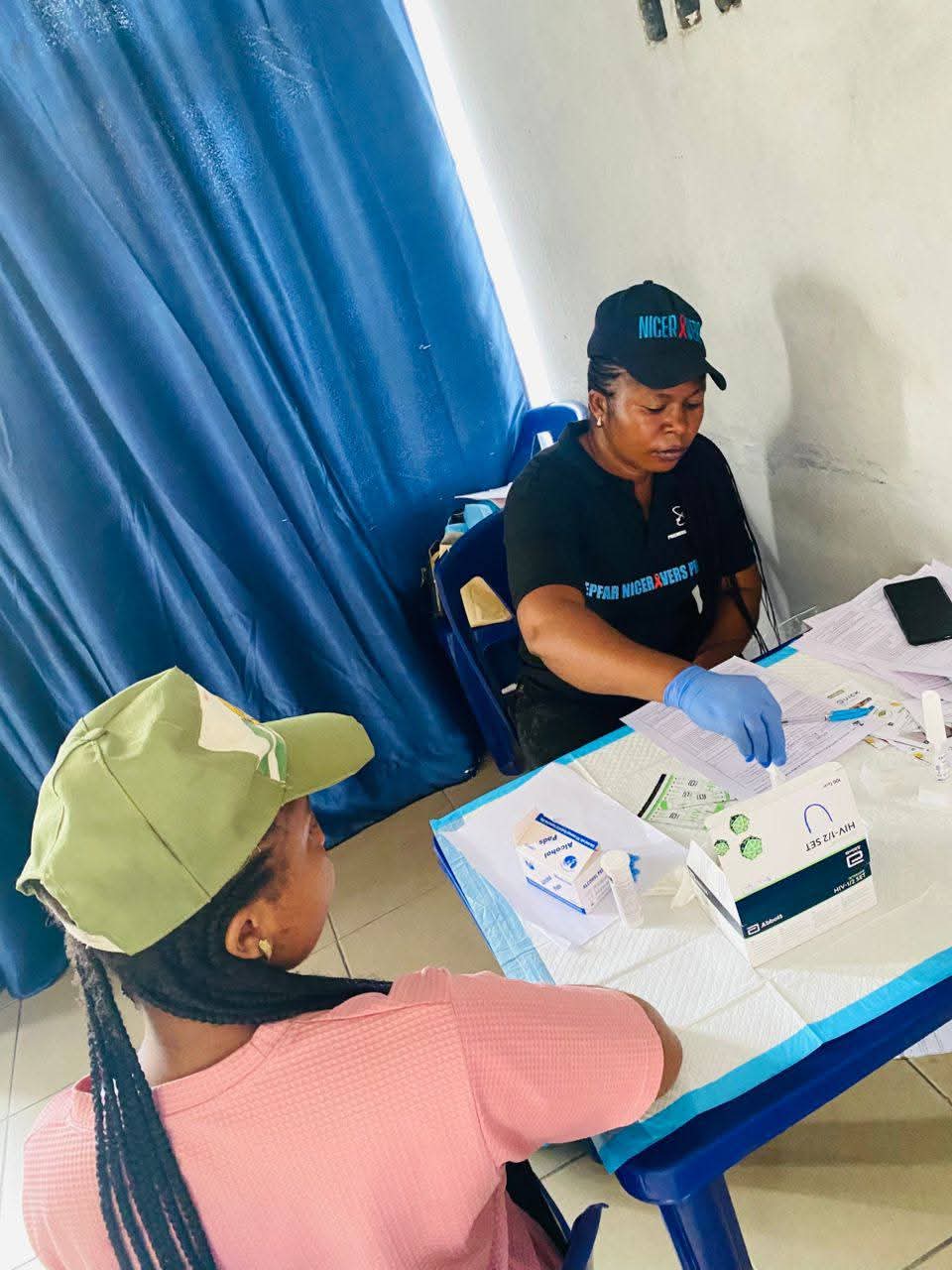
- Facilitate confidential, timely referrals from virtual engagement into HIV testing, prevention (including PrEP) and treatment services.
- Institutionalise electronic Community-Led Monitoring so that service users can report on the quality and responsiveness of HIV services.
- Strengthen the capacity of community structures and key population-led groups to lead demand creation and accountability work.
Target populations
- AYPAdolescents and young people
- SWSex workers
- MSMMen who have sex with men
- PWIDPeople who inject drugs
- TGTransgender people
Funding and partners
NICERIVERS is funded under PEPFAR. PCI implements in collaboration with RivSACA and works alongside the Rivers State Ministry of Health, the Institute of Human Virology Nigeria (IHVN), ECEWS (Excellence Community Education Welfare Scheme) on CDC/PEPFAR-supported community-led HIV work, and community-based organisations.
Approach
How the project actually runs
Virtual messaging
Structured HIV messaging delivered through social platforms, messaging apps and moderated virtual spaces, designed for the language, literacy and privacy needs of the audience.
Confidential referrals
Trained virtual navigators link interested users to nearby testing, prevention and treatment services, with consent-based follow-up and no exposure of identity in group settings.
Electronic Community-Led Monitoring
Community monitors collect structured feedback on availability, quality and treatment experience using electronic tools, then feed findings back to facilities, RivSACA and partners for action.
Stakeholder engagement
Regular engagement with state agencies, facilities and community networks so that monitoring findings translate into service-level changes rather than reports.
Project
Integrated Health Technical Assistance Project
Integrated Health Technical Assistance builds on the proven “hub-and-spoke” model, where major health facilities serve as hubs providing training, mentorship, supervision, commodities/supplies, and referral support to a network of community clinics and health posts.
Target populations
The initiative focuses on vulnerable and underserved populations, particularly people living with HIV, pregnant and breastfeeding women, and adolescent girls, who face disproportionate risks related to HIV, stigma, early pregnancy, and gender-based violence.
- People living with HIV
- Pregnant and breastfeeding women
- Adolescent girls
Geographic scope and service integration
Across Rivers, Bayelsa, and Sokoto States, the programme strengthens integrated HIV, maternal, newborn and child health (MNCH), malaria, tuberculosis (TB), and nutrition services at both community and facility levels.
- HIV
- Maternal, newborn and child health (MNCH)
- Malaria
- Tuberculosis (TB)
- Nutrition
Demand generation and Community-Led Monitoring
It will also strengthen demand for health services through virtual spaces and Community-Led Monitoring (CLM), enabling communities to identify service gaps, generate demand, monitor quality and access, and inform responsive health-system improvements.
- Identify service gaps
- Generate demand
- Monitor quality and access
- Inform responsive health-system improvements
Health Security Systems Strengthening for Energy Corridor States Project
Health Security Systems Strengthening for Energy Corridor States project, implemented by the Premium Care Initiative (PCI), provides technical assistance to strengthen the capacity of Rivers, Delta and Bayelsa States to prevent, prepare for, detect, and respond to public health threats. The project strengthens One Health governance, State Action Plans for Health Security, health security financing, policy and legislative frameworks, workforce capacity, and emergency preparedness, including hazard and vulnerability assessments, contingency planning, simulation exercises, after-action reviews, PHEOC readiness, Incident Management Systems (IMS), Rapid Response Teams (RRTs), IPC, case management, and antimicrobial stewardship.
The project strengthens IDSR, event-based, indicator-based and community-based surveillance, laboratory capacity, specimen referral systems, and digital surveillance through SORMAS, SITAWARE and GIS-enabled platforms. It supports outbreak investigation, contact tracing, laboratory response, risk assessment, RCCE, logistics, and multidisciplinary emergency coordination. Virtual spaces and Community-Led Monitoring (CLM) are leveraged to increase demand for health services, address misinformation, strengthen community feedback and improve public trust. Overall, the project supports resilient, data-driven and sustainable health security systems capable of rapidly detecting and responding to emerging and re-emerging public health threats.
Project
ECEWS SPEED Project
Strengthening Community-Led HIV Services and Paediatric ART Outcomes in Delta, Osun and Ekiti States
Under the ECEWS SPEED Project, Premium Care Initiative (PCI) is strengthening the capacity of Community-Based Organisations (CBOs) to deliver high-quality, community-led HIV care, treatment, support and retention services across all Local Government Areas in Delta, Osun and Ekiti States.
Working in close partnership with health facilities and implementing partners, we bridge the gap between communities and formal health systems so that people living with HIV — especially children and adolescents — are identified early, started on treatment, retained in care and supported to achieve viral suppression.
Closing Critical Gaps in the Paediatric HIV Treatment Cascade
Persistent challenges in paediatric case finding, treatment access, retention and follow-up continue to leave too many children and adolescents behind. In response, PCI is implementing the Community Case Management Programme (CCMP) alongside integrated violence-protection interventions as part of a focused Paediatric ART Saturation Strategy.
This coordinated model brings together CBOs, community case managers, facility care and treatment teams, and implementing partners to improve performance at every stage of the cascade.
Key interventions
ART refill and retention
Strengthening case management and active follow-up to reduce treatment interruptions and protect continuity of care.
Viral load monitoring
Supporting timely sample collection, result tracking and clinical action.
Paediatric case identification and enrolment
Intensifying identification, linkage and treatment initiation for HIV-Exposed Infants (HEI) and Children and Adolescents Living with HIV (C/ALHIV).
PMTCT strengthening
Improving community–facility linkages to support prevention of mother-to-child transmission and sustained care.
Violence protection
Integrating screening, documentation and reporting through designated hub sites to address vulnerabilities that undermine treatment outcomes.
Re-engagement of clients lost to follow-up
Strengthening community tracing to bring children and adolescents back into care.
Data-driven coordination
Enhancing real-time information flow between CBOs, case managers, facilities, hub sites and partners for accountability and rapid response.
From Identification to Viral Suppression
By linking community case management with facility-based services, PCI is building a seamless continuum of care — from first identification and enrolment through ART initiation, refill, viral load monitoring, retention and re-engagement.
CBOs are positioned as essential partners in delivering responsive, community-based HIV services while strengthening collaboration with health facilities and implementing partners.
Our goal is clear: no child or adolescent living with HIV should be missed, left untreated, lost from care, or left behind on the path to viral suppression and a healthier future.
Work streams
Our four portfolios
Projects are time-bound and donor-funded. Portfolios describe the capability PCI maintains regardless of any single funding cycle.
Health Systems Strengthening
Supporting facilities, community structures and state agencies to deliver reliable, people-centred health services — from service-delivery support and data use to quality improvement and referral coordination.
- Facility and community service-delivery support
- Integrated service delivery for HIV, tuberculosis, malaria and maternal, newborn and child health (MNCH)
- End-to-end referral pathways, continuity of care and equitable access for marginalized populations
- Health security systems strengthening across Nigeria’s energy corridor states: disease surveillance, laboratory system expansion, public health workforce development, emergency preparedness and response planning, risk communication, cross-sector coordination and health information system optimization
- Data quality, documentation and use for decision-making
- Coordination with State Ministries of Health and agencies
Livelihood Protection
Protecting the economic base of vulnerable households so that health gains are not reversed by income shocks, combining savings-led group models with social protection navigation and skills support.
- Village Savings and Loan Association (VSLA) training
- Group formation, governance and record-keeping
- Generating demand for national social safety net, livelihood support and economic empowerment programming
- Community navigators connecting marginalized groups to social protection and livelihood opportunities
- Strengthening local community systems for long-term, sustainable economic resilience
- Economic strengthening linked to health outcomes
Epidemic Control
Contributing to Nigeria's HIV epidemic control targets through demand creation, testing linkage, treatment support and community-led monitoring of service quality, with PCI serving as implementing partner for the PEPFAR-funded NICERIVERS Project.
- Implementing partner for the PEPFAR-funded NICERIVERS Project
- Secure, user-centric virtual platforms reaching adolescents, young people and priority/underserved populations with accurate, stigma-free HIV and reproductive health information
- Demand generation and confidential referral linkage for testing, treatment and prevention
- Community-Led Monitoring (CLM) of service delivery
Environmental Sustainability
Working with communities on environmental health and sustainability, recognising that a safe environment is a precondition for durable health and livelihood outcomes. Primary attention is on industrial pollution in the Niger Delta region and the impacts of climate change and unsustainable farming practices across northern Nigeria.
- Industrial pollution response and advocacy in the Niger Delta region
- Climate change and unsustainable farming practice mitigation across northern Nigeria
- Policy advocacy, grassroots community engagement and cross-sector partnerships
- Community environmental health awareness
- Sustainability considerations across programmes
- Partnerships with local and state stakeholders
Current projects vs. portfolios
At present, NICERIVERS is PCI's principal externally funded project. Livelihood protection work — including Village Savings and Loan Association (VSLA) training, social protection navigation and economic empowerment support — and environmental sustainability activity are delivered as portfolio work streams and community engagements rather than as separately funded projects. CBO capacity strengthening is advanced through the ECEWS-SPEED Grant portfolio. New projects will be listed here as they are awarded.
Collaborate
Bring a programme to your state or community
We are open to co-design with funders, state agencies and community organisations outside Rivers State.